Bedroom Furniture · Sleep Environment
A Closer Look at Solid-Wood Platform Bed Frames
A platform bed can make a bedroom feel settled and thoughtfully put together. When it is made from solid wood, the grain, joinery, finish, and proportions become part of the room’s character—not just details hidden beneath the mattress. Here’s what to look for when comparing construction, planning a layout, and choosing a frame you’ll be happy to live with.
Published November 21, 2026
Why solid wood makes a difference
A bed frame occupies a generous stretch of visual space, even when the room is simply furnished. Solid wood brings natural variation to that space: a shifting grain pattern, subtle changes in tone, and the tactile character of a material that doesn’t look exactly the same from one piece to another. Those qualities can make a bedroom feel warmer and more personal without relying on an elaborate headboard or decorative extras.
There is a practical side, too. A well-built frame needs to hold a mattress steadily through ordinary nightly movement and everyday use. The strength of a bed depends on more than the words “solid wood” on a description. Species, component dimensions, connections, center support, and how the frame is assembled all matter. Looking at those details offers a more useful comparison than choosing by appearance alone.
For a Minnesota bedroom, the appeal can be especially easy to understand. Long stretches of cold weather often bring more time indoors, and a bedroom that feels calm and inviting can become a welcome retreat. Wood isn’t a substitute for comfortable bedding or a healthy sleep routine, of course, but the right frame can help make the room feel grounded, orderly, and suited to everyday life.
Platform beds, in plain terms
A platform bed is designed to support a mattress on a built-in surface, commonly a series of slats or a solid platform. Many platform frames do not require a separate box spring, but that does not mean every mattress works with every frame. Mattress manufacturers set requirements for the type and spacing of support, so check those instructions before settling on a bed.
The platform design can simplify a bedroom setup: fewer foundation pieces, a clear profile, and a direct relationship between mattress and frame. It can also change the room’s proportions. A low frame may make a small bedroom feel more open, while a taller one can make getting in and out easier and provide extra room underneath. Either choice can be right; the useful question is how the dimensions work for the people, mattress, and space.
Platform frames are not all alike. Some emphasize a broad, solid-looking base; others use visible legs and a more open profile. Some are spare and contemporary, while others draw on traditional woodworking. The phrase “platform bed” describes the support arrangement, not a particular style or level of craftsmanship.
Start with wood species and character
Different hardwoods have distinct appearances and working properties. Maple is often associated with a relatively even, subtle grain; cherry commonly develops a warm color that can deepen with exposure to light; walnut is recognized for richer brown tones and expressive grain. These are broad tendencies, not guarantees. A board’s exact appearance depends on the tree, how it was cut, the finish, and the way the maker selects and combines components.
When browsing photographs or samples, consider whether you want the frame to blend into the background or become a focal point. A quiet grain and restrained finish can pair easily with patterned bedding, while more pronounced figuring may provide plenty of visual interest on its own. Neither approach is inherently better. The goal is to choose a piece that works with the rest of the room rather than competing with it.
Ask what “solid wood” means in the specific product description. A frame may use solid hardwood for its main visible parts while other components use different materials. That is not automatically a drawback, but clarity helps you understand what you are buying. Look for information about the rails, slats, legs, headboard, and any panels, and ask questions if the description leaves important construction details unclear.
It is also worth separating the appeal of a wood species from assumptions about performance. A particular name alone cannot tell you whether a frame will be quiet, stable, or suited to your mattress. Construction and support matter alongside the material, and a well-made design should explain how its parts work together.
Joinery: the connections behind the look
Joinery refers to the way wooden parts connect. On a bed, those connections help determine how the rails attach to the headboard and footboard, how legs meet the frame, and how the structure can be taken apart for a move. A carefully designed joint can contribute to a frame’s stability, but no single joinery term guarantees quality on its own. The overall design, fit, hardware, and execution matter.
Traditional joinery may be part of a frame’s visual and construction story, while other designs rely on sturdy mechanical fittings. Either way, the connection should be appropriate to the parts being joined and practical for assembly. If a bed arrives in pieces, ask how many people are recommended for setup, what tools are needed, and whether the manufacturer provides clear instructions.
It is sensible to check how the frame is braced. A center rail and supporting legs may be important, especially on larger sizes, because the middle of a mattress needs appropriate support. Slat spacing is another key detail: mattress makers often specify a maximum gap or minimum number of slats. Confirm those requirements rather than assuming all platform frames are interchangeable.
Finally, think about the possibility of future disassembly. A frame that can be assembled securely and taken apart carefully may be easier to move between homes. If you expect to relocate, ask whether repeated assembly is supported and whether replacement hardware is available.
Finish, feel, and everyday care
A finish influences both appearance and routine maintenance. Oil finishes tend to emphasize the wood’s natural character and may leave a tactile, less glossy surface. Other finishes can create a more sealed or polished look. Product descriptions may call a finish eco-friendly, but that phrase is not a substitute for understanding the finish itself. If indoor-air quality or particular ingredients matter to your household, ask the manufacturer for specific information and documentation.
Care instructions should be realistic for the way you live. Dusting with a soft cloth and dealing promptly with spills are common-sense habits, but the right cleaning method depends on the finish. Avoid assuming that a household cleaner, wax, or polish is suitable for every surface. Follow the maker’s care advice, and ask before using a product that could alter the sheen or leave residue.
Wood can respond to changes in its surroundings. Heating systems, dry winter air, sunlight, and indoor humidity can affect natural materials over time. Avoid placing a frame directly beside a heat source or where strong sunlight falls on one area for long periods. In Minnesota, where indoor air can become dry in winter, maintaining a reasonably stable home environment may help care for wood furnishings generally. Follow the frame maker’s guidance for the specific finish and conditions.
Small signs of daily use are not necessarily a flaw. Natural wood is a living-looking material, with grain and color variations that contribute to its character. Before ordering, make sure you are comfortable with the maker’s expectations for variation, sample differences, and how the finish may change with age and light.
Proportion matters as much as style
A beautiful frame can feel awkward if its size overwhelms the room or leaves too little space to move around. Measure the room, the intended mattress, and the full exterior dimensions of the bed. A “queen” or “king” label tells you the mattress size the frame is intended to accommodate, but the headboard, rails, and legs add to the footprint. Check the product’s measurements rather than estimating from the mattress alone.
Think through the route into the bedroom, too. A large frame may need to pass through a narrow hallway, stairwell, or doorway. If it ships in sections, confirm the dimensions of the largest pieces and whether delivery includes bringing them into the room. Planning ahead can prevent a frustrating surprise on setup day.
Then consider how much visual weight the frame will bring. A substantial wooden bed can anchor a larger room, but a compact bedroom may benefit from a simpler silhouette and open space beneath the rails. Nightstands, drawers, lamps, and door swings all need room to coexist. A quick floor plan—or even masking tape laid out on the floor—can help you picture the footprint before making a commitment.
Frame height also affects how the whole bed feels. Measure from the floor to the top of the support surface, then add the mattress height. That combined measurement gives a better sense of the finished bed than the frame height alone. If the bed will be shared by someone with mobility needs, consider how easily they can sit down, stand up, and reach nearby items.
Don’t overlook under-bed clearance
The open space beneath a platform bed affects both appearance and function. More clearance can make vacuuming easier and may accommodate storage containers, while a lower profile can create a streamlined look. Measure the actual space beneath the side rails, not just the height of the legs: rails or center supports may reduce the usable area.
Storage can be useful, but it is worth weighing convenience against visual clutter. If you plan to keep boxes under the bed, confirm their height and width and make sure they can slide in and out without catching on supports. If you use a robot vacuum, check its clearance requirements and consider whether the frame has enough space for the machine to pass underneath.
Think about airflow and cleaning as part of the same decision. A frame with no clearance may be right for a particular room or design, but it offers fewer options for under-bed cleaning and storage. The best arrangement depends on the household’s priorities and routines rather than a universal rule.
Two solid-wood designs to compare
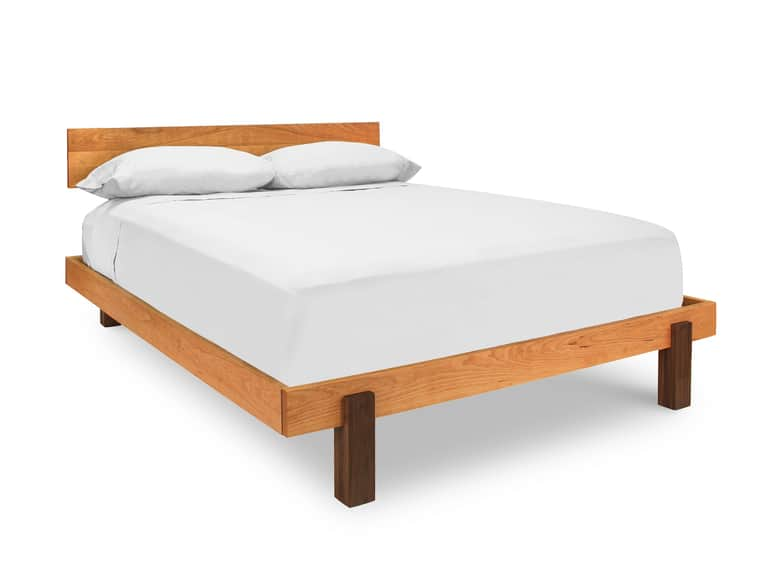
Product descriptions can make different frames sound similar, so it helps to compare the details they actually provide. The Modern American Platform Bed is described as a solid-hardwood platform design with clean, smooth lines and an Art Deco influence. Its listing specifies an eco-friendly oil finish and natural walnut legs. Those details suggest a frame whose visual interest comes from its profile, wood, and finish rather than ornate decoration. Before choosing it, confirm the exact hardwood composition, dimensions, support details, and care instructions for the configuration you are considering.
The Pendant Bed is described as solid cherry wood with traditional joinery, a hand-applied oil finish, and a simple modern design. Its listing notes that it is made in Vermont and can be customized in a choice of hardwoods. For a shopper comparing solid wood bed frames, those are useful points to explore: which woods are available, how the finish affects their appearance, and whether the construction and mattress support meet the needs of the room.
Neither description should be treated as a substitute for checking specifications. Ask about the support system, mattress compatibility, assembly, shipping, finish care, and the product’s complete dimensions. It can also be helpful to request finish samples if available, particularly when coordinating a bed with existing wood furniture. The aim is not to find the most impressive-sounding feature; it is to understand how the frame will function and look in your own home.
How to compare makers thoughtfully
When comparing names such as Maple Corner Woodworks, or any other maker, keep the evaluation grounded in verifiable product information. A name, regional identity, or attractive photograph cannot by itself establish the materials, construction, or care requirements of a specific frame. Look for clear descriptions and ask direct questions when details are missing. If information is not published, a retailer or maker may be able to clarify it before you order.
A useful comparison list includes species, which components are solid wood, finish type, support layout, slat spacing, center support, dimensions, assembly requirements, warranty terms, delivery arrangements, and care instructions. If customization is offered, confirm what can change and whether that affects lead time, price, or return terms. Keep the answers together so you can compare products on the same basis.
Consider the maker’s approach to repairs and replacement parts as well. A frame is a substantial piece of bedroom furniture, and practical support may matter over time. Ask how to address a damaged component or missing piece, and read warranty conditions closely. Clear information makes it easier to set realistic expectations without relying on general claims about longevity.
Build a more comfortable sleep space around it
The bed frame is only one part of a sleep environment, but it can help the room feel more coherent. Match the overall bed height to the mattress and bedding you use. Choose sheets with pockets deep enough for the complete mattress setup, including any topper or protector. Make sure the mattress is supported according to its manufacturer’s instructions, especially if it has specific requirements for slats or a foundation.
In Minnesota, seasonal changes can influence bedroom comfort. Cold winter nights may call for adjustable layers, while warmer, more humid periods can make breathable bedding and air circulation feel especially welcome. A wooden frame does not regulate room temperature, but its simplicity can provide a steady foundation while you change quilts, duvets, or sheets throughout the year.
Keep the room’s everyday rhythms in mind. Leave a comfortable path from the bed to the door, make switches and reading lights easy to reach, and avoid crowding the frame with furniture. If you share the bed, consider whether both people have enough room for nightstands and independent access. A restful space is often less about a perfect decorative scheme than about reducing small daily frictions.
A practical checklist before you decide
- Confirm mattress compatibility. Check the mattress maker’s requirements for platform support, slat spacing, and foundations.
- Read the material description carefully. Find out which parts are solid wood and which species are used.
- Ask how the frame is supported. Look for clear information about slats, center rails, and support legs.
- Measure the full footprint. Include the headboard, rails, and any protruding feet, not just the mattress dimensions.
- Measure height and clearance. Account for the mattress, ease of getting in and out, cleaning, and any planned storage.
- Understand finish care. Request specific cleaning instructions and ask how the surface may change over time.
- Plan for delivery and assembly. Check access routes, package dimensions, tools, and the number of people needed for setup.
- Review the terms. Understand warranty coverage, return conditions, customization details, and availability of replacement parts.
The best frame is the one that fits real life
Solid-wood platform bed frames bring together material, structure, and room design in one everyday piece. Wood species shapes the visual character; joinery and support influence how the frame is assembled and used; and finish affects both the look and the care routine. Height, clearance, and exterior dimensions determine whether the bed makes sense for the room once it is in place.
A thoughtful choice does not have to be complicated. Compare the specifications, ask about anything that remains unclear, and picture the frame in the context of your mattress, furniture, and daily habits. Whether you favor the smooth lines of a hardwood platform design or the warmth of cherry and traditional joinery, the right bed should feel considered without making the bedroom feel overworked.
Ultimately, a calm sleep environment grows from details that work together: dependable mattress support, comfortable bedding, accessible layout, and furniture that feels at home in the room. A well-chosen wooden platform frame can provide a grounded starting point—quietly practical by day and ready for rest when the evening comes.